
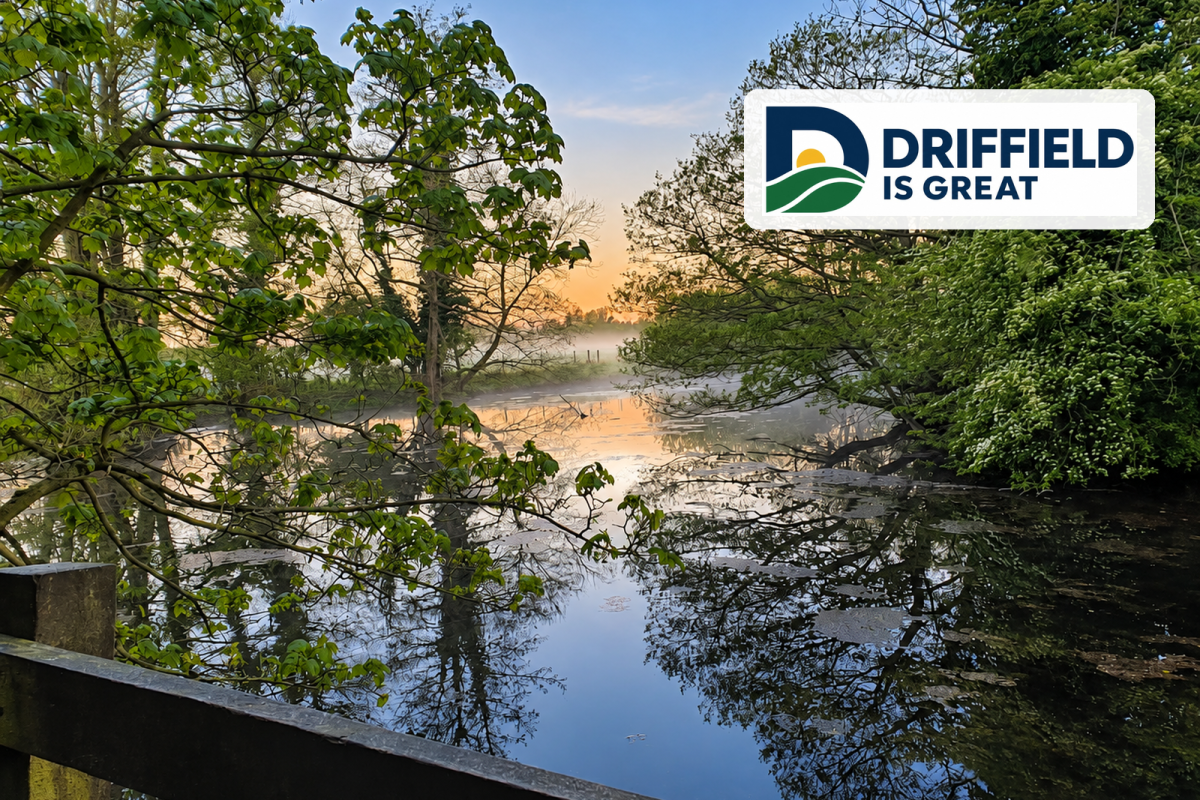
Driffield Millennium Green: The Wildlife Haven Hidden on the Edge of Town
Just a few minutes from the centre of Driffield is a place where the noise of the town quickly gives way to birdsong, open grassland, ponds and one of the most environmentally important landscapes in the area.
Driffield Millennium Green covers around eight acres at King’s Mill and provides something increasingly valuable: an area of open countryside right within the town boundary.
Created in 2000 with support from the Millennium Green Commission, the Green is managed for the benefit of the community by the Driffield Millennium Green Trust. Its official charitable purpose is simple but important — to provide and maintain an open space for the general benefit of local people.
Today, however, Millennium Green is much more than an attractive place to take a walk.
It has become an important haven for wildlife, a place for environmental education and a practical example of local organisations working together to protect the natural environment around Driffield.
Countryside on Driffield’s doorstep
One of Millennium Green’s greatest strengths is how accessible it is from the town.
Discover Driffield describes it as the last remaining piece of open countryside within Driffield’s town boundaries, offering a peaceful rural area only a short walk from the centre.
That makes it valuable in several different ways.
For some people, it is simply somewhere quiet to walk.
For families, it offers children an opportunity to experience wildlife and natural habitats close to home.
For walkers, the area forms part of the early stages of the Wold Rangers Way and its associated shorter routes, as well as providing access to other walks around the parish boundary.
And for wildlife, the ponds, grassland and wet areas provide habitat within a much wider network of environmentally significant countryside.
A landscape with a long history
The importance of this part of Driffield did not begin with the creation of Millennium Green.
The site sits in the King’s Mill area, which local historical information records as having connections stretching back to the Domesday Book.
Water has played a central role in the landscape for centuries.
Driffield lies at the eastern edge of the Yorkshire Wolds, where water emerging from the chalk feeds the headwaters of the River Hull.
Those headwaters are nationally important.
The River Hull Headwaters are designated as a Site of Special Scientific Interest, and Natural England’s restoration plan identifies them as Britain’s most northerly chalk-stream system.
That means the watercourses and wetland habitats around Driffield are not simply attractive local features — they form part of a nationally significant freshwater environment.
Why chalk streams matter
Chalk streams are a particularly distinctive type of river.
Their water filters through chalk before emerging from springs, generally producing clear, mineral-rich water with relatively stable temperatures.
These conditions can support a diverse range of plants, fish and invertebrates.
The Environment Agency confirms that local chalk streams feed into Driffield Beck and Driffield Trout Stream, which eventually combine with other watercourses to form the River Hull.
For Driffield, that means some of the natural environment visible around Millennium Green forms part of a much bigger ecological system stretching through East Yorkshire.
A home for great crested newts
One of Millennium Green’s most important residents is also one that many visitors may never see.
The wetland area supports a population of great crested newts, and habitat work has specifically been undertaken to protect and improve their breeding ponds.
During autumn 2023, East Yorkshire Rivers Trust worked with the Millennium Green trustees, Wold Ecology, Bishop Burton College and local contractors on a major programme of wetland improvements.
One of the larger ponds had become heavily overgrown with willow and was at risk of gradually drying out.
Some of the willow was therefore removed or reduced and the pond was deepened to improve the habitat available to amphibians.
A second, smaller pond close to two public footpaths was also protected using a natural dead hedge made from timber and willow sourced on site.
The barrier helps discourage dogs from entering the pond and disturbing what is a particularly sensitive habitat.
It is a good example of conservation work that is relatively unobtrusive but can make a significant difference to wildlife.
Wildflowers, orchids and insects
The Green’s environmental value is not limited to its ponds.
Local information records a variety of flora and fauna across the site, including rare orchids, while its grassland, trees, hedges and wet areas provide different habitats within a relatively small area.
This variety is important because wildlife rarely depends on one isolated feature.
Ponds need surrounding grassland and shelter.
Pollinating insects need flowering plants.
Birds rely on insects, seeds, trees and scrub.
And connected habitats give species somewhere to move, feed and reproduce.
That makes Millennium Green an important little piece of a much larger environmental jigsaw.
Conservation shaped by the community
Perhaps the most encouraging part of the Millennium Green story is that much of its improvement has happened through partnership.
Environmental work has involved organisations including:
- East Yorkshire Rivers Trust
- Wold Ecology
- Bishop Burton College
- Millennium Green trustees
- specialist local contractors
- community volunteers.
Projects have included pond restoration, willow management, wildlife protection, tree planting and environmental education.
The Green has also been used by local schools for wildlife activities and educational visits, giving younger residents a chance to experience the natural world without travelling far from town.
That community connection is particularly important.
Protecting wildlife does not have to mean fencing nature away from people.
At Millennium Green, the aim is instead to help residents enjoy the area while understanding why parts of it need careful management.
Making the Green easier to enjoy
Recent improvements have not focused solely on wildlife.
Access has also been an important part of the work.
East Riding Council’s UK Shared Prosperity Fund records an award of £17,810.40 to the Driffield Millennium Green Trust for the Millennium Green All Access Project, designed to improve access to the site.
Local information also records the installation of an accessible path, alongside picnic benches made by Driffield Men in Sheds.
These improvements help more people enjoy the Green while directing visitors along routes that can reduce unnecessary disturbance to more sensitive areas.
A place to walk, pause and explore
You do not need to be a wildlife expert to enjoy Millennium Green.
Part of its value is simply having an open, natural place within walking distance of Driffield town centre.
Depending on the season, visitors might notice wildflowers, butterflies and other insects, birds around the trees and wetland areas, or simply the changing colours and character of the landscape.
It also works particularly well as the beginning or end of a longer walk.
The Wold Rangers Way, which starts and finishes in Driffield, passes through this area as it heads from the town into the Yorkshire Wolds.
For anyone who has read our Wold Rangers Way guide, Millennium Green helps illustrate something particularly special about Driffield: the transition from town to countryside can happen remarkably quickly.
Enjoying the Green responsibly
Because Millennium Green contains sensitive wildlife habitat, a little consideration goes a long way.
Visitors can help by:
- keeping to established paths where possible
- keeping dogs under close control around ponds and wildlife areas
- not allowing dogs to enter protected ponds
- taking litter home
- avoiding picking wildflowers
- leaving logs, dead wood and natural habitat features where they are
- allowing wildlife plenty of space.
Some of the features that might look untidy in a traditional park — dead wood, long grass, willow structures or patches of dense vegetation — may actually be there because they provide valuable habitat.
Why places like Millennium Green matter
Millennium Green is not a grand country park or a major visitor attraction.
And perhaps that is exactly why it deserves attention.
It is a relatively small patch of countryside woven into the everyday life of Driffield.
People walk through it.
Children learn about nature there.
Wildlife breeds there.
Volunteers help look after it.
Environmental organisations use it to demonstrate practical habitat management.
And paths through the Green connect the town with the wider Yorkshire Wolds landscape beyond.
In a growing town, spaces like this become increasingly important.
They give wildlife somewhere to live, provide residents with access to nature and preserve a connection between Driffield and the countryside that surrounds it.
A green space worth protecting
It can be easy to travel elsewhere looking for nature while overlooking what is already on our doorstep.
Driffield Millennium Green is a reminder that some of the area’s most interesting wildlife and environmental stories are happening only a few minutes from the centre of town.
From nationally important chalk-stream habitat and great crested newts to community conservation work and local walking routes, there is much more here than first meets the eye.
Next time you are passing King’s Mill, it may be worth slowing down, taking a walk through the Green and seeing just how quickly Driffield gives way to the natural landscape of the Yorkshire Wolds.
And perhaps most importantly, it is a place that belongs to the community — one that has been shaped, protected and improved by people who believe that a little piece of countryside inside Driffield is worth looking after.